Rocho’s escape from Lipce
The PeasantsRocho’s escape from Lipce is a flight from a gendarme search made possible by the villagers’ quick coordination and willingness to shelter him. The episode moves from alarm at the sight of the authorities to a quiet, improvised hiding place, then to a tearful farewell and a final gathering at the edge of the woods. Rocho leaves not as a solitary fugitive, but amid acts of concealment, care, and shared hope.
The Search Begins
The alarm starts when Grzela, the Voyt’s brother, sees britzkas standing before the presbytery and gendarmes on its porch. After questioning the drivers, he races to find Mateusz, who is working at Stacho Płoszka’s cottage, notching the ridge beam in preparation for the rafters. The uncertainty about why the authorities have come is itself enough to set the warning in motion. Grzela crosses the gardens and wheat field to the Boryna household, where he finds Antek Boryna hammering a sickle on the porch and tells him what is happening.
The response is immediate. Michał the blacksmith offers to rally the village rather than hand Rocho over. Antek directs Rocho to hide beyond the rick, in a furrow in the rye, and tells him to stay there until summoned. Before slipping away, Rocho gives papers to Józka Boryna, who is lying in bed, and asks her to conceal them beneath herself. He leaves the cottage without his cap or capote and disappears into the orchard; beyond the rick, the rye is left swaying where he has passed.
A Village Hides Him
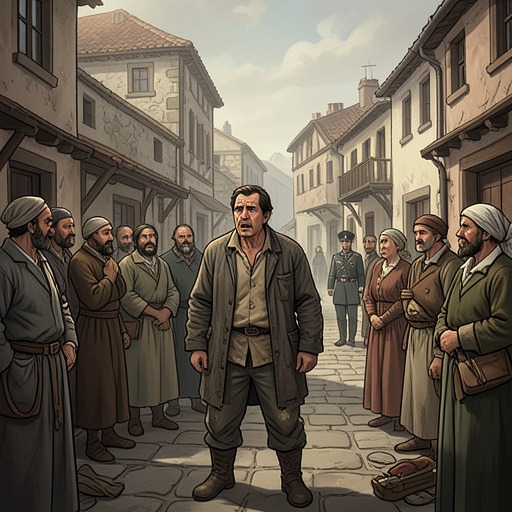
The gendarmes question Antek and warn that anyone found sheltering Rocho will be taken with him. Antek says he does not understand what the matter is, while the searchers go from cottage to cottage, peering around and questioning whoever they can. They leave only after sunset, having found nothing. The sequence gives the search a broad reach but no successful conclusion: Rocho remains hidden, and the villagers’ readiness to warn and protect him has deprived the authorities of the information they seek.
Once the gendarmes ride away, the village exhales into a rush of talk. People recount the searches at the Kłąbs’ and at Grzela’s and Mateusz’s, each emphasizing how closely they watched events and how boldly they faced the gendarmes. The chatter turns a fearful episode into a performance of collective nerve. Yet the danger is not over, and Antek waits until the roads empty and households settle to supper before moving Rocho again. He brings him to Józka’s side of the cottage without letting the fire be stoked, keeping the departure as inconspicuous as possible.
Farewell and Departure
Rocho takes a quick bite, gathers his things, and begins saying goodbye to the women. Hanka Borynowa falls at his feet, while Józka breaks into sobs. He embraces them and kisses their heads, blesses the children and the house, crosses himself, and sets off toward the stile by the hayrick. Antek gives him a practical plan: horses will be waiting at Szymek’s in Podlesie, and Mateusz will take him onward. Rocho says that he still has one person in the village to visit, extending the farewell beyond the household sheltering him.
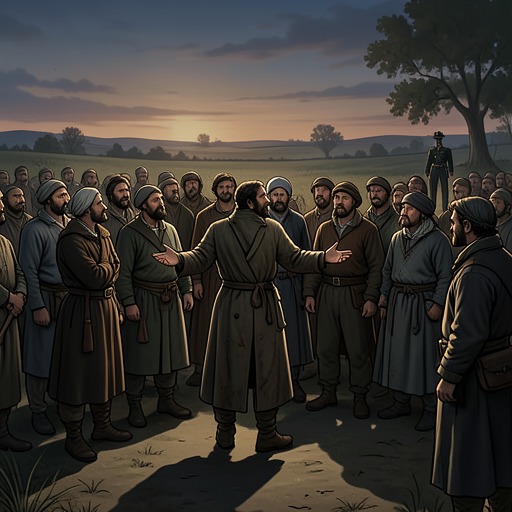
The departure also gathers a larger circle. At a cross on the edge of the woods, Rocho sees white figures in capotes and cautiously asks who is there; they answer that they are friends. His words to the assembled listeners are described as momentous and unexpected. They hear them with fear and joy together, as though they have received a solemn promise. The passage does not set out the speech’s particulars, but it shows its effect: the listeners remain silent, absorbed, and newly hopeful.
The Parting’s Meaning
When Rocho says it is time to go, he embraces and kisses each person in farewell. He kneels to pray, then falls face down and presses his arms against the earth, as if embracing a mother he must leave forever. Jagusia sobs, and the men furtively wipe their eyes. The group parts quickly; only Antek and Jagusia return to the village, while the others disappear somewhere by the wood. Rocho’s escape thus ends in both separation and solidarity: the practical arrangements carry him away from the search, while the embraces, prayer, and gesture toward the earth make clear the cost of leaving. His flight is also a farewell to a place and community to which his presence has mattered.